Treatment of Hearing Loss in Children
Read here about what to expect when your child has a hearing loss that requires treatment with hearing aids, Bone Anchored Hearing System (BAHS), or a Cochlear Implant (CI).
Hearing Loss (HL) requires lifelong treatment. That’s why we place great emphasis on a playful approach that motivates children and helps make visits to our department a positive experience—for both your child and you as a parent.
To ensure your child gets the best possible benefit from their hearing technology, the treatment includes medical audiology care, sometimes surgery, technical support, and speech and language therapy. Children with HL aged 0–5 are also offered Auditory Verbal Therapy (AVT) for up to 3 years. Children and young people aged 6–18 with a CI are offered up to 1 year of AVT.
Our treatment is based on clinically applicable research and well-established knowledge, delivered by a multidisciplinary team—always in close collaboration with you as a parent and with your child’s needs at the centre. While we are the experts in treatment, you are the expert on your child. This means that we incorporate your experiences with your child into our treatment and do our best to ensure that this knowledge can be applied at home.
Your child will be assigned a speech-language pathologist, who will be your primary point of contact. You are always welcome to reach out to them with any concerns or questions.
Hearing aids and BAHS
![]()
At the first visit, we will typically:
- Review your child’s hearing curve (audiogram), which tells us about your child’s hearing loss and shows how well your child hears different tones
- Talk about why it’s so important that you stimulate your child’s hearing with speech and sound (auditory stimulation)
- Choose the hearing aid/BAHS that best suits your child’s needs
- Take ear impressions (for hearing aid molds)
- Schedule a time for the fitting of the devices
At the fitting of the hearing aids/BAHS, we will:
- Adjust the hearing aids/BAHS based on your child’s audiogram. Together with you and your child, we find the appropriate level of amplification. For BAHS fittings in particular, a type of play audiometry (in-situ measurement) is carried out from around age three, or whenever the child is ready to participate
- Go through the practical aspects of using the hearing aids/BAHS, such as battery replacement, cleaning of earmolds, and more
Around one month after the fitting, you will attend a follow-up appointment, where we check how things are going with your child’s use of the hearing aids/BAHS. Your child will then enter a follow-up programme with regular hearing assessments, depending on its age and needs.
A typical hearing assessment includes:
- A session of around 2–3 hours, including hearing tests and consultations with an audiologist and a speech and language pathologist
- A discussion about how things are going with the hearing technology at home and in nursery/school
- Possible adjustments of the hearing aids/BAHS based on the hearing test to ensure the right level of amplification
If you need to adjust the sound of the hearing aids between follow-up appointments, you are always welcome to contact the department to book an adjustment appointment. Phone: +45 3545 8047, press 2.
Cochlear Implant (CI)
If your child has a severe hearing loss, an assessment may be carried out to determine whether your child is a candidate for a CI. A CI is an advanced hearing technology that can provide artificial hearing sufficient to support the development of spoken language.
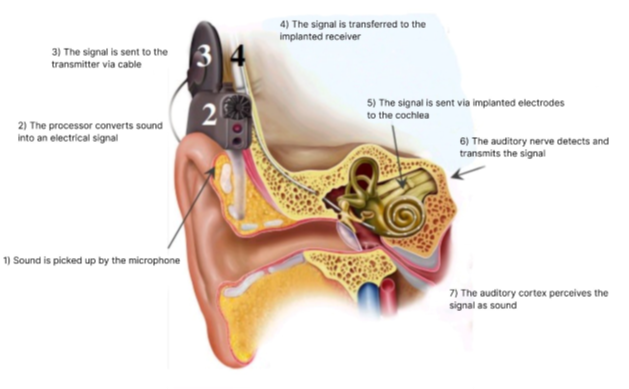
Source: SST, Kliniske retningslinjer for pædiatrisk cochlear implantation i Danmark, maj 2012
A CI consists of two parts:
The internal part includes an implant with an electrode that is surgically placed under the skin and into the inner ear. The external part, the processor, sits on the ear and is held in place on the head by a magnet.
Put simply, the CI works by electrically stimulating the inner ear close to the auditory nerve. This stimulation is perceived as sound in the brain.
The assessment usually includes hearing tests while your child is asleep or under general anesthesia, an MRI scan, and preassessment conversations with an audiologist, surgeon, and your speech and language pathologist. These conversations include a review of the hearing test results, a demonstration of the implant and processor, and information about the CI surgery and the post-operative process.
Based on the full assessment, it is then decided whether your child is eligible for the operation. CI surgery typically takes 2–3 hours and involves a hospital stay of around one day. Afterwards, your child should stay home for approximately 10 days until the surgical wound has healed.
In addition to being assigned a speech and language pathologist, your child will also be assigned a CI technician. The processor is fitted and handed over 2–3 weeks after the operation. At this appointment, there is also time to talk through the practicalities of daily life with a CI. From this point on, your child will become a full-time CI user.
Following the initial fitting, the next appointment usually takes place about two weeks later, then around three months after that. During the first year, follow-up appointments occur approximately every three months. Thereafter, your child will be seen every six months, and eventually once a year. These annual check-ups continue until your child turns 18, after which they will need to request appointments themselves when needed.
The adjustment process varies from child to child. At follow-up appointments, we check the implant and the processor settings, and ask how things are going with the CI at home and in nursery/school.
If there is a need for support between check-ups, you are always welcome to contact your child’s technician or speech and language pathologist for a service or adjustment appointment.
In case of emergencies during weekends or public holidays, you can contact the CI companies directly:
Auditory Verbal Therapy (AVT)
AVT is an effective approach for supporting language development in children with hearing loss. It is an internationally recognised method that focuses on stimulating the child’s auditory sense – the sense of hearing. The method has been tested in Denmark with more than 400 children with hearing loss, and since January 2023 it has been offered as a standard treatment. It is currently available to:
- children aged 0–5 years with a hearing loss requiring treatment (using hearing aids, bone anchored hearing systems or cochlear implants) – for up to three years
- children/young people aged 6–18 years who receive a cochlear implant – for up to one year
As part of the AVT programme, you and your child will regularly attend sessions at the department. The frequency is adjusted based on your child’s development and needs.
A playful approach to developing hearing and language
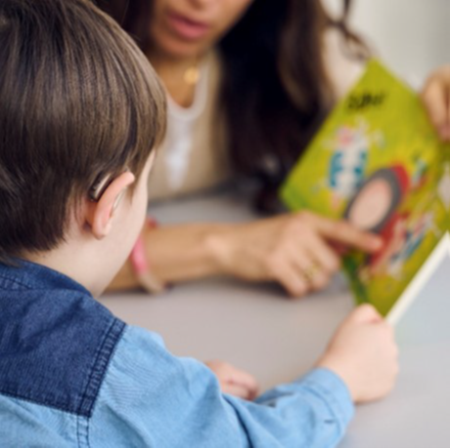
AVT uses a playful approach, and many parents talk to their young child about “going to play” when they come for an AVT session. You and your child will be assigned a dedicated AV therapist (a speech and language pathologist who is either trained or undergoing training in AVT).
The method is parent-centred and focuses on both hearing and spoken language. During an AVT session, you will learn techniques and strategies to help your child develop their listening skills and spoken language. These strategies are based on everyday situations – for example, when your child is getting out of a chair or counting 1-2-3 steps as you walk up a staircase.
AVT is based on typical language development. For each session, individual goals are set, and you will receive inspiration and ideas for how to play and communicate at home – always tailored to your child’s development and needs, and always in close collaboration with you as a parent.
As part of the AVT programme, annual language assessments and ongoing monitoring are conducted.
The final AVT session is always a celebration, and your child will receive both a certificate and a medal.
Modified AVT
Since our approach is diagnostic, it is tailored to meet your child’s specific needs. If spoken language stimulation alone is not sufficient, we incorporate additional language strategies – such as visual support – in combination with the auditory guidance. See the communication continuum below.

If you have questions
For further information, you are welcome to email MA speech and language pathologist, Marianne Kyhne Hestbæk: marianne.kyhne.hestbaek@regionh.dk
Why we work with AVT
In studies of Danish children with cochlear implants who were diagnosed early and used hearing aids before early implantation, we observed that they did not sufficiently develop age-appropriate language skills before starting school.
International intervention studies have shown that – when the goal is optimal audibility and spoken language outcomes – specialised auditory and spoken language rehabilitation in the form of AVT is required.
The latest data from Copenhagen Hearing and Balance Centre shows that children who have completed a three year AVT programme score comparably to the for children with typical hearing.
The same pattern is seen when it comes to well-being. This means that in terms of both challenges and social strengths, these children score similarly to their typical hearing peers.
Children with hearing loss and additional difficulties
Approximately 25% of children with hearing loss also have other challenges. These may include cerebral palsy, varying degrees of autism, dyspraxia, or dyslexia. In a long-term study, we found that this group of children in AV intervention may experience slower auditory and language development, but over a period of six years, they developed within the normal range for language. Their vocabulary, complex language skills, and ability to understand speech in noise im-proved over time.
If your child has additional difficulties besides hearing loss, you may notice a slower pace of development. It is important to continue training your child’s auditory sense and to work individually with your child’s potential to develop expressive communication in a modified AVT programme.
Quality Assurance in AVT
At the Copenhagen Hearing and Balance Centre, we have established a database to monitor children’s development in areas such as language and well-being at a group level. The purpose is to ensure that children progress as expected and that the highest professional standards in the AV intervention are continuously maintained.
More knowledge about AVT
The 3-year AVT programme, introduced in January 2023, is based on eight years of research and implementation work to establish AVT in Denmark. At the Copenhagen Hearing and Balance Centre, we have been part of this work in collaboration with, among others, the Department of Audiology at Aarhus University Hospital, the Hearing Clinic at Odense University Hospital, and the patient association Decibel – the National Association for Children and Young People with Hearing Loss (now part of the Danish Hearing Association ‘Høreforeningen').
Based on this work, Decibel (Høreforeningen) developed various materials that explain AVT in more detail. You can find them here: decibel.dk/AVT. Please note that the page is no longer being updated. To see who is currently offered AVT at Copenhagen Hearing and Balance Centre, please refer to the information on our website.
AVT has had a great impact for both children and parents and has made it possible for many children to attend their local daycare or school. The AVT programme also provides long-term economic benefits to society. You can read more in the AVT IMPACT RAPPORT 2022, which was also produced by Decibel.
If you would like to learn more about the knowledge behind AVT, we have compiled a selection of articles on brain plasticity, early intervention, and AVT.
Film about AVT
A short film that offers a glimpse into what it’s like to attend AVT sessions here at the department. You’ll meet 6-year-old Vera, who is attending AVT together with her parents.
Link to video
App – We hear with the Brain
Many of us believe we hear with our ears, and that hearing loss is therefore only a problem with the ears. But that’s not entirely true — we hear with the brain, and the role of the ears is to transmit sound from the environment to the brain.
For children with HL, we use hearing technology to strengthen the signal sent to the hearing areas of the brain. This is especially important because the auditory areas in the brain are less stimulated in children with HL loss than in children with typical hearing. Fortunately, this isn’t critical — if your child receives the correct hearing technology as early as possible and wears it for as many hours a day as possible.
We’ve developed the “PreHear” app as a supplement to the information you receive from the professionals at the Copenhagen Hearing and Balance Centre. The app offers you a more interactive way to understand brain plasticity — the brain’s ability to reorganize itself — and why working with it is so important for your child with HL.
You can download the app for free using the QR codes below. We do not collect any data from the app. The app is intended for parents and other caregivers of children with HL.

Apple Appstore Google Play

App – Warble goes for hearing examination
“Warble til Høreundersøgelse” is an app designed to help your child get ready for a hearing examination In the app, you follow a little bear named Warble who is going to a hearing examination here at the department. Together with Warble, you’ll complete fun and engaging tasks — for example, Warble shows how ears are cleaned and how to get through the hearing examination in a playful way.
The app is aimed at children aged 2–5 years and can be downloaded for free using the QR codes below. We do not collect any data from the app.
 Apple Appstore Google Play