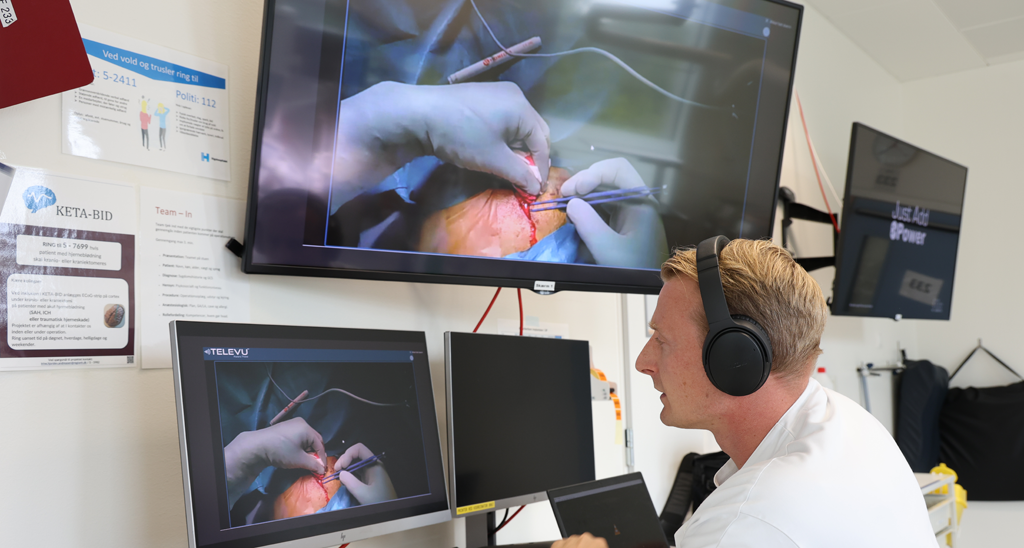
Brain surgeon Jeppe Lohfert Haslund-Vinding shows how he can follow an operation from his computer and instruct the surgeons in Nuuk.
- Make the incision here, says the voice in Najannguaq Jørgensen's ear. At the same time, lines appear on the patient's head on the small screen in the glasses in front of her eye.
Najannguaq Jørgensen is a surgeon in the operating theatre at Queen Ingrid's Hospital in Nuuk, and she is operating on a patient with acute bleeding in the brain while a brain surgeon at Rigshospitalet in Copenhagen supervises. This is possible because she is wearing smart glasses that reproduce what she sees for the surgeon in Denmark.
Safer
In Greenland, approximately 10 people a year hit their head in a way so that they suffer from an acute brain haemorrhage. When this happens, Najannguaq Jørgensen and her colleagues from Queen Ingrid's Hospital call the Department of Neurosurgery at Rigshospitalet. Previously it was to examine the possibility of evacuating the patient for treatment in Denmark, but with the smart glasses it is now also possible to help acutely ill patients in Nuuk, even though there are no brain surgeons in Greenland.
- It can take 6-48 hours to evacuate a patient for treatment in Denmark, and every minute matters for the patient's life and mobility in cases of an acute brain haemorrhage. We rarely see this type of patient, so it's safer for the patient and for us to have an experienced brain surgeon with us through the smart glasses. The brain surgeon is used to the procedure, guides us, and is ready with answers if we have any questions along the way, says Najannguaq Jørgensen.
The brain surgeon in Denmark only needs a computer or smartphone to watch the proceedings in the operating theatre in Greenland. Through the camera and microphone in the smart glasses, he can see and hear the same things as the surgeon in Greenland, and using the screen, he can draw and explain how the operation should be performed. The surgeon in Greenland can voice control the smart glasses, so there is no need to touch them with her hands during surgery.
Like standing there yourself
According to Jeppe Lohfert Haslund-Vinding, a registrar at the Department of Neurosurgery and initiator of the project, the method is simple and safe.
- Using this technology, I watch the operation as if I were standing behind a colleague and instructing during the operation. The technology is intuitive and easy to use from both sides of the Atlantic. However, it was important to train users of the equipment before pressing the start button. Therefore, we visited each other and trained in surgery for acute brain haemorrhage, and in using brain surgery equipment and smart glasses," says Jeppe Lohfert Haslund-Vinding.
When there is urgent need
If you hit your head hard, an acute haemorrhage can occur under the skull, compressing the brain tissue. To relieve pressure on the brain, the surgeon drills a hole in the patient's skull where the bleeding is. Exactly this need to relieve the pressure on the patient's brain makes the new collaboration so important:
- An acute brain haemorrhage requires rapid intervention. Most other conditions that require brain surgery allow time to fly the patient to a brain surgeon in Denmark. This technology makes no changes in these situations. On the other hand, this new, better opportunity to help is a gift for patients, our colleagues in Nuuk and ourselves. In the future, when our colleagues have their backs against the wall with a patient with an acute brain haemorrhage, we can watch and support them. Both we and our skilled and experienced colleagues in Nuuk are very happy about this, says Jeppe Lohfert Haslund-Vinding.
Torshavn next
The initiative has been so successful in Greenland that Jeppe Lohfert Haslund-Vinding and his colleagues already are preparing a similar collaboration with a group of surgeons at Torshavn National Hospital in the Faeroe Islands.
- It's great that we can collaborate with our colleagues in Greenland and the Faeroe Islands to alleviate some of the inequality that arises due to the large geographical distances. If we can save just one life, then I think the project has succeeded, says Jeppe Lohfert Haslund-Vinding.