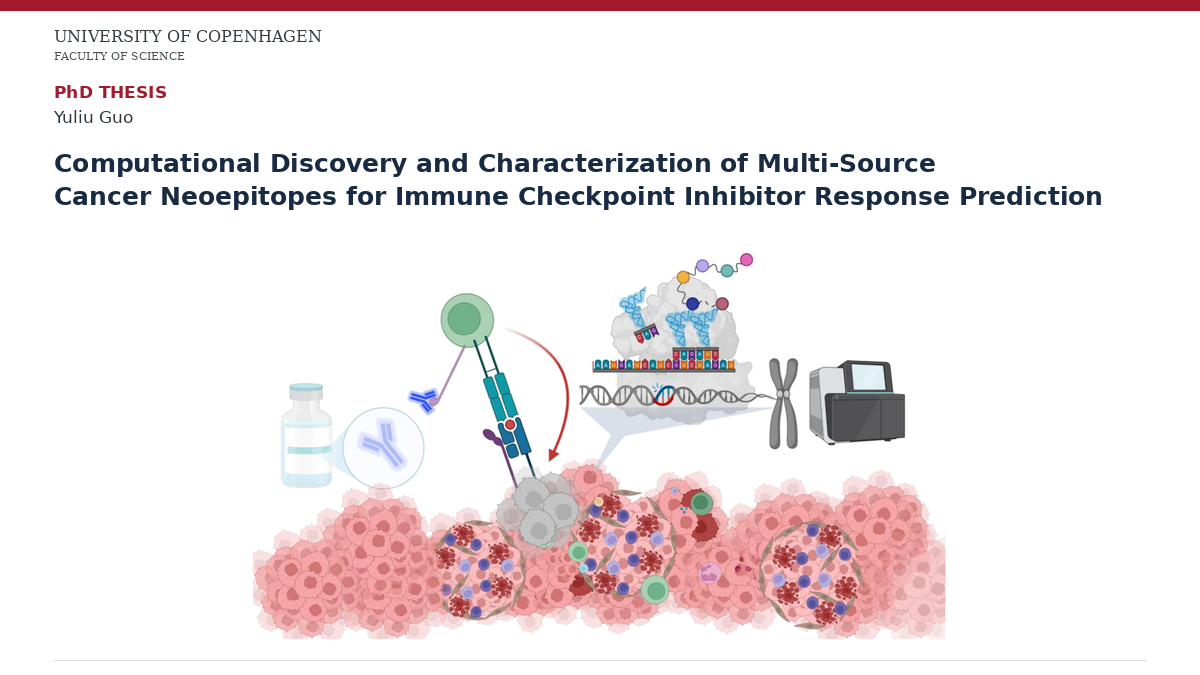
Immune checkpoint inhibitors (ICIs) are cancer treatments that aim to restore the immune system’s ability to recognise and attack cancer cells. While these treatments can lead to durable clinical responses, only a subset of patients benefit from them. Identifying reliable biomarkers that can predict treatment response is therefore an important step towards more personalised cancer treatment.
Yuliu Guo’s research explored potential biomarkers for predicting response to ICIs through a combination of computational methods and multi-omics analyses. The work included a benchmarking study of detection of structural variants using short-read sequencing data, as well as an analysis of patients with advanced or metastatic solid tumours treated with PD-L1 inhibition in the ProTarget clinical trial.
By integrating genomic, transcriptomic and proteomic data, the study investigated potential neoepitopes arising from different types of genomic alterations and examined their relationship with the tumour immune microenvironment and treatment response.
The research was conducted in close collaboration with MDxCore, the Phase 1 Unit at Rigshospitalet, and the University of Copenhagen.
Overall, the thesis contributes to ongoing research into biomarkers associated with response to immune checkpoint inhibitors. By combining variant detection, neoepitope prediction and characterisation of the tumour immune context, the work adds new insights into factors that may be associated with treatment response and provides a basis for further investigation.