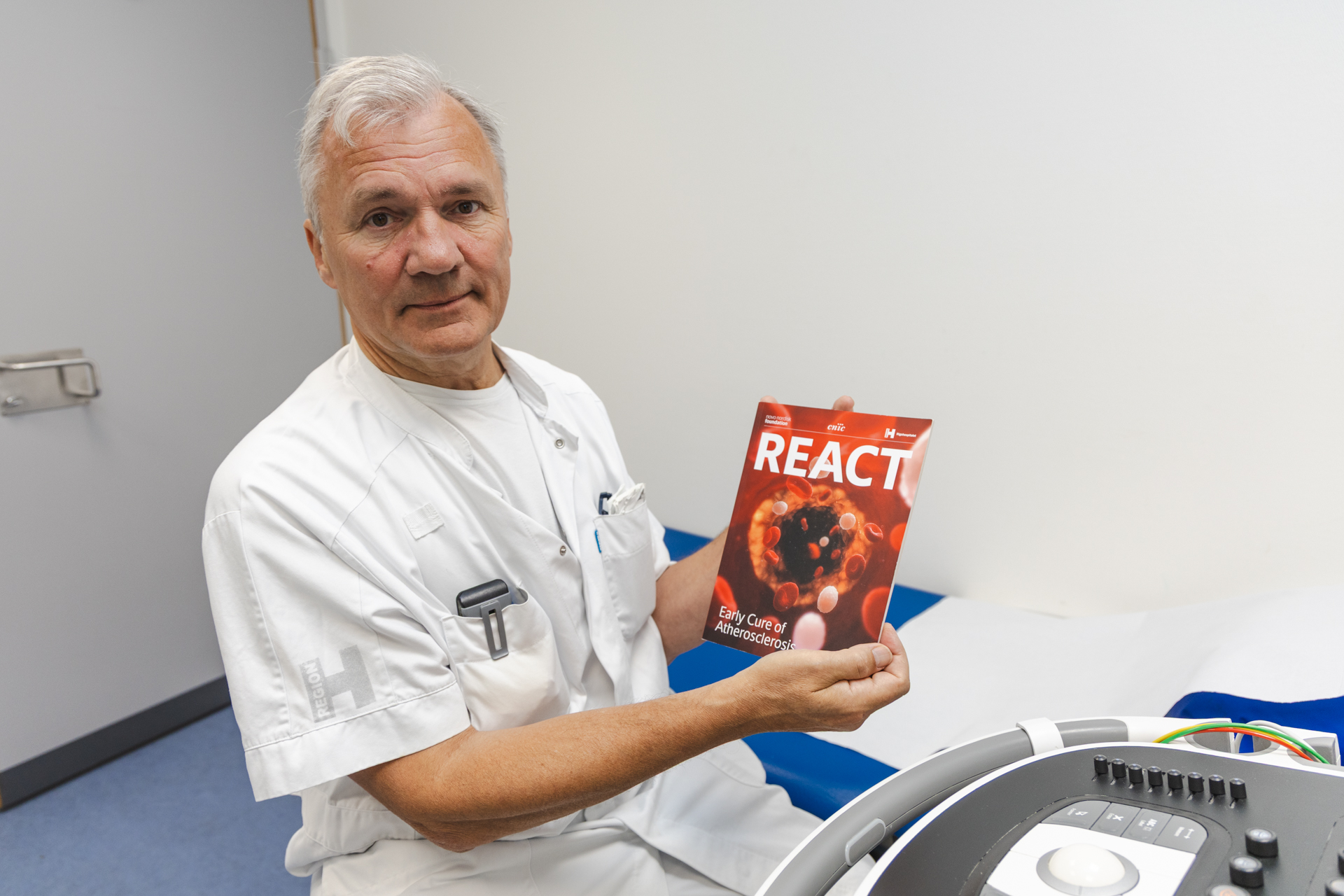
 Henning Bundgaard, Consultant Cardiologist at the Department of Cardiology at Rigshospitalet, Professor at the University of Copenhagen and lead of the REACT project.
On Saturday morning, global knowledge about atherosclerosis – and therefore the prospects for early detection, prevention and treatment – changed significantly when the results of a major Danish-led study were presented at the international ESC Congress in Munich and simultaneously published in the New England Journal of Medicine, one of the world’s most highly regarded and influential medical journals.
Remarkable, groundbreaking and crucial are adjectives that researchers are usually cautious about using when describing research findings – unless the data support such claims. In the case of the first published results from the large-scale Danish-led REACT study, however, they are justified.
- The potential here is enormous, and this may be the world’s largest and perhaps, at the moment, most important project – at least in terms of its potential to save a great many lives and improve the quality of life for many more, says Henning Bundgaard, Consultant Cardiologist at the Department of Cardiology at Rigshospitalet, Professor at the University of Copenhagen and lead of the REACT project.
Over the past two years, more than 16,000 healthy adults aged 18 to 70 in Denmark and Spain, with no previously known atherosclerosis, have been examined for hidden atherosclerosis in the arteries of the heart, neck and legs using various forms of medical imaging, including advanced 3D ultrasound scans and CT scans.
A major health burden
The findings from the first phase are both striking and significant for our understanding of atherosclerosis, which is currently the single largest cause of cardiovascular disease and therefore one of the world’s most serious public health challenges. More than 500 million people worldwide live with cardiovascular disease, and more than 18 million die from it every year.
- We have long known that atherosclerosis can begin developing at an early age and often remains ‘silent’, meaning without symptoms, for many years until a person suddenly suffers an event such as a blood clot. With this project, we have established how early silent atherosclerosis begins and how it spreads from one area of the body to another as we age, says Kasper Iversen, Professor and Chief Physician at the Department of Cardiology at Herlev and Gentofte Hospital, who is also involved in the research project.
If atherosclerosis can be detected early in life, this could create new opportunities to prevent cardiovascular disease and thereby reduce the substantial disease burden caused by atherosclerosis.
REACT reflects a broader development in healthcare, where the ambition is increasingly to prevent disease rather than only treating it once damage has occurred.
In cancer care, screening and early diagnosis have been central tools for many years. Now, the same approach is gaining ground in cardiovascular medicine.
Extensive findings
The researchers found signs of hidden atherosclerosis in 57.1% of participants. The disease could already be detected in approximately one in 13 people aged 18–29. Among those aged 60–70, nine out of ten showed signs of atherosclerosis.
Atherosclerosis develops earlier in men than in women. In women, the increase occurred later but accelerated around the menopause, after which women ‘caught up’ with men. At the same time, increasing age was associated with a spread of atherosclerosis to multiple areas of the body, while the amount of atherosclerotic plaque in the blood vessels increased sharply – exponentially – with age.
In most people with atherosclerosis in the coronary arteries, the researchers also found atherosclerosis in the blood vessels of the neck, the legs, or both.
- Data from several different parts of the body support the view that silent atherosclerosis is a disease affecting the entire circulatory system and developing gradually. In men, the development of atherosclerosis appears to begin around five to ten years earlier than in women, says Morten Bøttcher, Professor at Aarhus University and Consultant Cardiologist at the University Clinic for Diagnosis, Treatment and Rehabilitation of Ischaemic Heart Disease at Gødstrup Regional Hospital, who is also involved in the research project.
Young people are being missed
The researchers also examined how well the traditional method for assessing cardiovascular risk – currently based on factors such as age, sex, smoking, blood pressure and cholesterol – identifies people with hidden atherosclerosis.
The study showed that only a small proportion of participants with hidden atherosclerosis were classified as being at high risk. This was particularly evident among younger people, many of whom showed signs of atherosclerosis but were nevertheless not identified as being at particular risk.
- The current method assesses the risk of developing cardiovascular complications caused by atherosclerosis and therefore provides only limited information about whether a person actually has atherosclerosis. We therefore need direct detection of whether or not a person has atherosclerosis. Otherwise, we risk missing the opportunity to prevent cardiovascular disease in people in whom atherosclerosis has already developed, says Professor Bundgaard, adding:
- Detecting and treating silent atherosclerosis as early as possible is likely to be crucial if we are to reduce the global burden of cardiovascular disease. Our findings support the need for more prospective studies to determine whether imaging-guided treatment can improve current prevention strategies when early signs of disease are detected. If successful, this could be an important step towards more precise and targeted prevention of the most common form of cardiovascular disease.
The REACT Initiative is primarily a collaboration between Denmark and Spain, but the prevalence study has also been expanded to include researchers from India, Tanzania, Singapore and Mexico. This is partly motivated by the substantial global burden of atherosclerosis and the growing need to develop much more effective approaches to prevention.
The future of prevention
The researchers emphasise that the study findings do not mean that everyone should automatically be screened. Nor will everyone with atherosclerosis necessarily go on to develop cardiovascular disease. The results will instead be used to determine whether an entirely new approach to preventing atherosclerosis can be developed in the future.
The next phase of the REACT Initiative – Phase 2 of the study – will therefore aim to establish whether early prevention targeted at each individual’s risk factors can halt or limit the substantial age-related progression of atherosclerosis so clearly demonstrated in Phase 1.
If the necessary funding can be secured, Phase 2 will be a large randomised study starting in early 2027 and involving approximately 6,000 participants, who will be followed for around 3.5 years. This part of the REACT Initiative will also be carried out in close collaboration between the Danish and Spanish researchers.