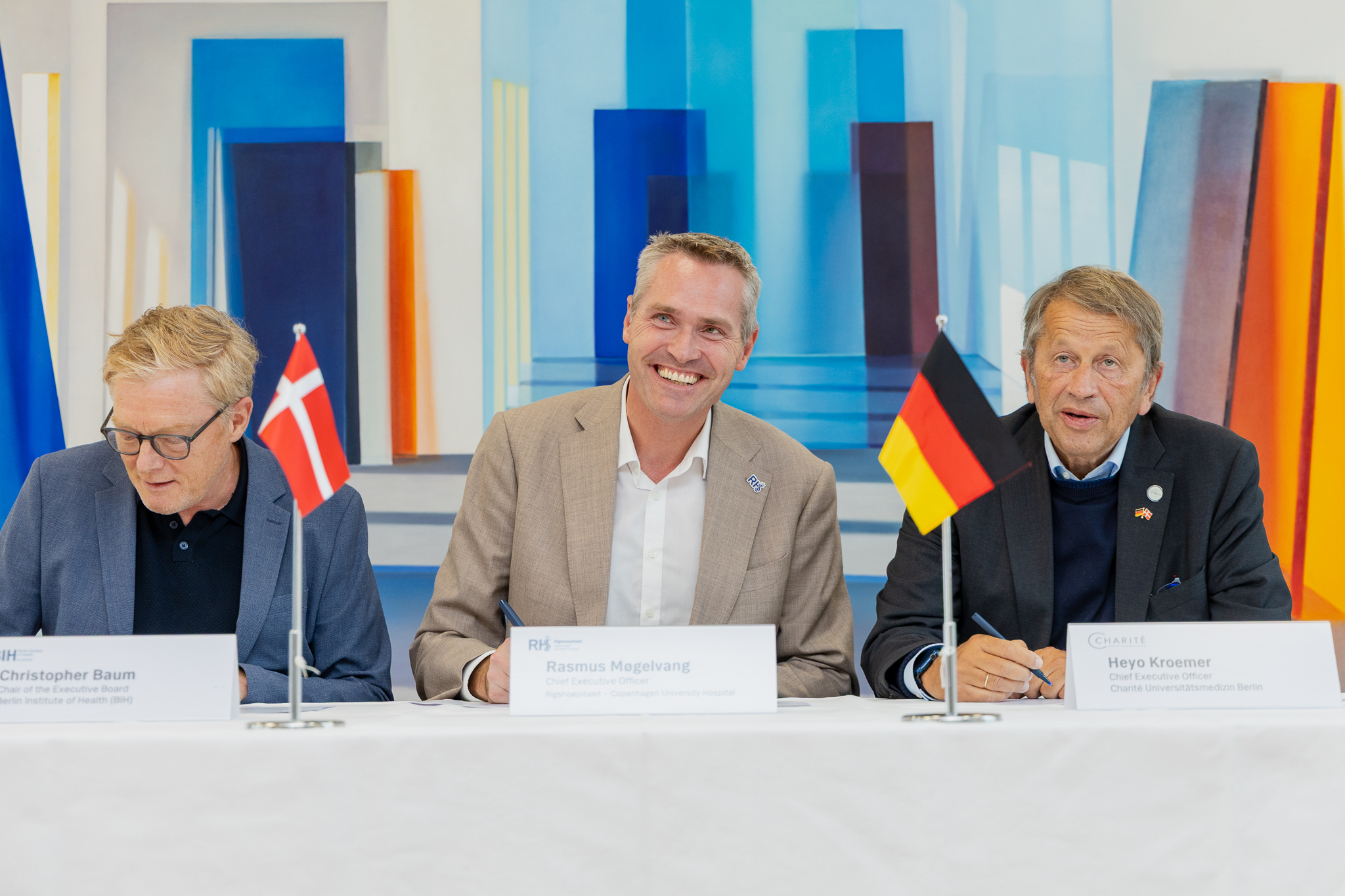
 There were flags on the table and smiles all around when a Danish-German partnership agreement was signed at Rigshospitalet on Wednesday afternoon.
At a time of a changing threat landscape, new technological opportunities and increasing complexity in healthcare, strong European partnerships are more important than ever.
That is why Rigshospitalet, Charité – Universitätsmedizin Berlin and Berlin Institute of Health at Charité (BIH) have entered into a five-year partnership covering research, innovation, emergency preparedness and the development of the healthcare system of the future.
The agreement was marked by a signing ceremony at Rigshospitalet on Wednesday afternoon. The memorandum of understanding was signed by Rigshospitalet’s Chief Executive, Rasmus Møgelvang, Chairman of the BIH Board of Directors, Professor Christopher Baum, and Chief Executive Officer of Charité – Universitätsmedizin Berlin, Professor Heyo K. Kroemer.
A special responsibility
Professor Heyo K. Kroemer, Chief Executive Officer of Charité – Universitätsmedizin Berlin, points out that university hospitals such as Charité and Rigshospitalet share a special responsibility to provide high-quality care – also under challenging conditions – and to collaborate and share knowledge across national borders.
“Charité and Rigshospitalet bring together strong expertise in cutting-edge research, education and clinical care. Through this partnership, we want to turn this expertise into concrete emergency preparedness strategies and more resilient structures in healthcare. University hospitals have a special responsibility to ensure high-quality care – also under challenging conditions,” says Professor Heyo K. Kroemer, Chief Executive Officer of Charité – Universitätsmedizin Berlin.
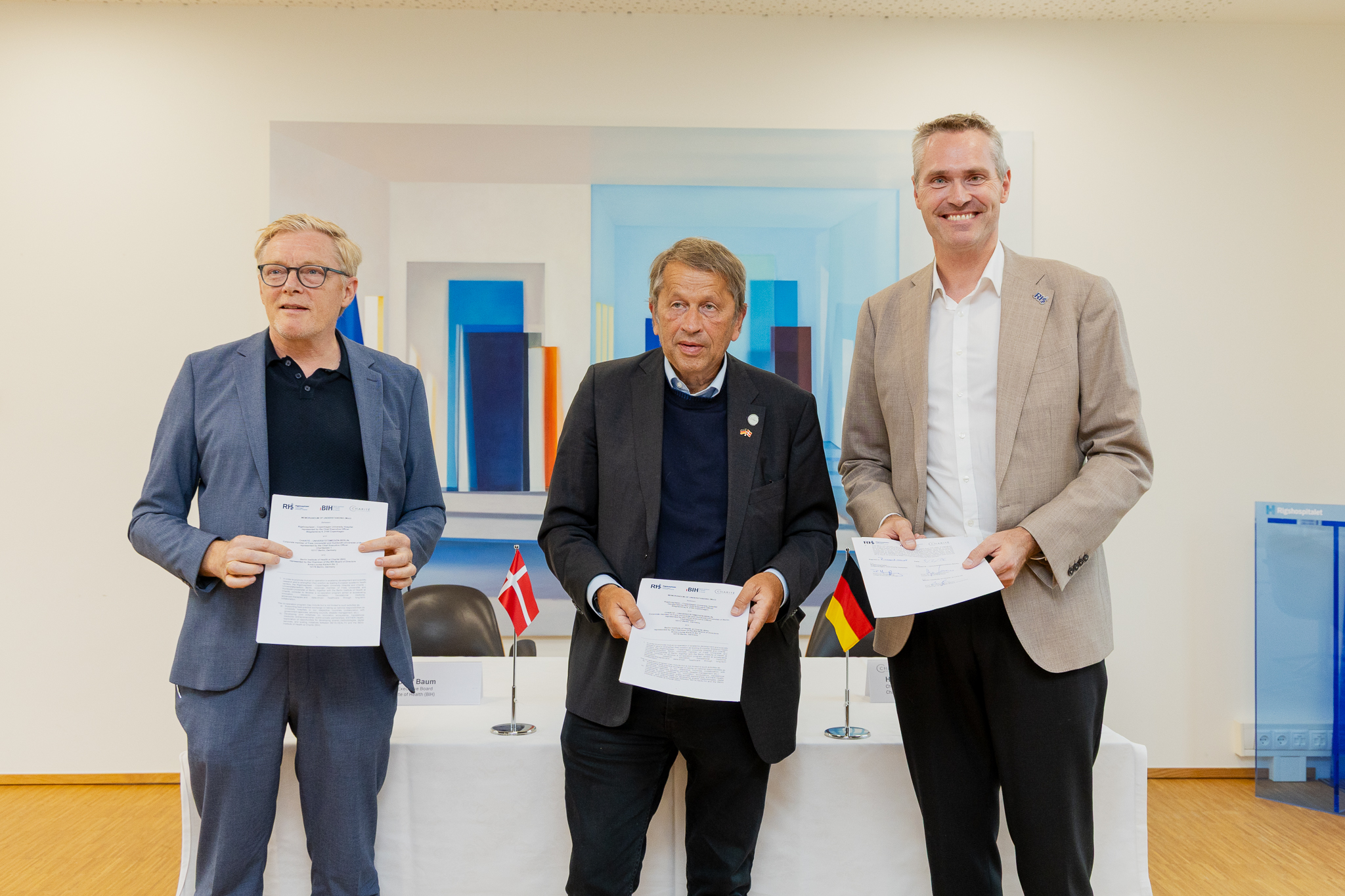
The partnership agreement will initially run for five years.
Expanded collaboration
The hospitals already work together to receive and treat patients from Ukraine and have experience of supporting each other during periods of peak demand.
The closer partnership will, among other things, strengthen the parties’ ability to respond to major crises, where there may be a need to share patients, staff, medicines, equipment and specialist expertise across borders.
“We are facing some complex challenges in a drastically changed threat landscape. That is why it is important that we can learn from each other, plan together and be able to support one another if we find ourselves in a critical situation,” says Rasmus Møgelvang, Chief Executive of Rigshospitalet.
Sharing knowledge
The agreement also paves the way for closer collaboration in areas including rare diseases, innovation, research and advanced treatments.
Together, two strong university hospitals with deep roots in their local communities can share knowledge and experience and help develop a more resilient European healthcare system.
“We need reliable alliances to ensure that Europe remains an attractive, stable and healthy place to live. This requires strong collaboration and close knowledge-sharing in vibrant and productive ecosystems,” says Professor Christopher Baum, Chairman of the BIH Board of Directors, adding:
“At the heart of this is the close integration of research and clinical practice, combined with targeted support for innovation and a strong data-driven approach. Our neighbour Denmark is an ideal partner for advancing this shared mission.”
The partnership between Rigshospitalet, Charité – Universitätsmedizin Berlin and Berlin Institute of Health at Charité is initially set to run for five years, with the possibility of an extension.