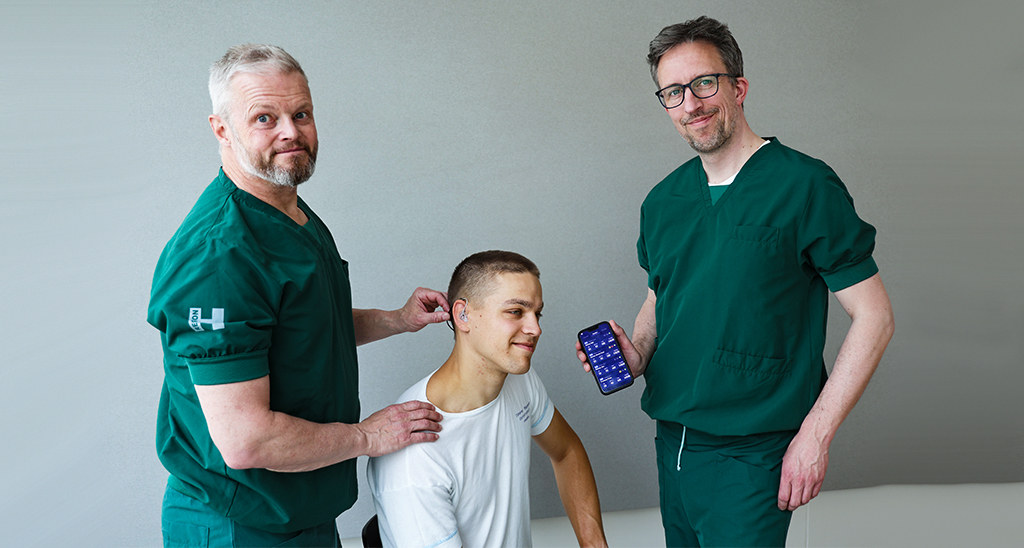
Photo: Professor Eske K. Aasvang (left side) and professor Christian S. Meyhoff are the driving forces behind the clinical research in the WARD project.
In future, a patient-friendly sensor in the ear coupled with artificial intelligence (AI) will help staff to keep an extra eye on patients at high risk of serious complications. This is the perspective of the public-private ONWARD project, which has just received a grant of DKK 30 million from Innovation Fund Denmark. The money will be spent on developing the CE labelled, AI WARD system with wireless ear-worn sensors.
Around 30 per cent of all patients who undergo major surgery, or who are admitted with an acute medical illness, experience serious complications, and earlier detection of signs of deterioration could prevent these complications and reduce costs.
The key is constant monitoring of vital signs such as blood pressure, oxygen saturation and pulse where deviations are early warnings of deterioration in the patient's condition, explains Professor Eske K. Aasvang, a consultant at the Department of Thoracic Anaesthesiology at Rigshospitalet and Professor Christian S. Meyhoff, a consultant at the Department of Anaesthesiology at Bispebjerg Hospital, who are the driving forces behind the clinical research in the WARD project.
"We've documented that the WARD system for monitoring patients can reduce the number of complications and unnecessary alarms as well as free up valuable labour. But the sensors could be more comfortable to wear for patients, and we believe that we can measure the patients' vital signs very accurately via the ear," said Eske K. Aasvang.
Brain activity measured in the ear
The ONWARD project is a collaboration between the WARD project from Rigshospitalet and Bispebjerg Hospital in the Capital Region of Denmark, the spinout company, WARD 24/7, and the Danish health tech company, T&W Engineering, which specialises in sensors to measure the body's vital signs.
Measurements in the ear can add new physiological data on patients' body function, and this could improve the current body sensors. Existing sensors are not optimally designed for easy and constant monitoring, especially not for registering vital signs such as blood pressure and oxygen saturation 24/7," explained Christian S. Meyhoff.
"We're working on a new design for a monitoring system with an AI assistant that can provide health care professionals with even better information about a patient's condition. Even though continuous sensors detect up to 20 times more deviations than staff do with manual measurements, optimal user-friendliness is important for implementation – both at hospital and in a patient's own home," said Christian S. Meyhoff.
About ONWARD:
The ONWARD project is running for four years and has a total budget of DKK 42.5 million, of which DKK 29.75 million comes from a Grand Solutions grant from Innovation Fund Denmark. The grant will be used to develop and test a new AI design and a portable multi-sensory system that is discreet and easy to use for patients.
ONWARD builds on two previous Grand Solutions grants from Innovation Fund Denmark awarded to T&W Engineering and to WARD. WARD was founded at Bispebjerg Hospital, DTU Healthcare Technology and Rigshospitalet.
The ambition is to develop a world-leading clinical support system that reduces complications and provides an overview and peace of mind for staff. The system will also make it easier for health care professionals to monitor patients in their own home.
Project participants:
Bispebjerg Hospital and Rigshospitalet: Clinical experts from the two hospitals have paved the way for the AI-supported clinical support system (WARD-CSS), which is now ready to be implemented in Denmark and abroad.
T&W Engineering: A Danish producer of medical devices, which develops patient-friendly multi-sensory body-worn measuring systems and AI assisted interpretation of raw sensor data for long-term and continuous generation of vital parameters, including assessment of brain function (brain sensing).
WARD 24/7 ApS: A Danish spin-out company from the WARD project specialising in AI-based interpretation of vital signs, communication with health care professionals and development of IT infrastructure for health care applications.